WOLF-2 — Pack Leader
WOLF-2 "PACK LEADER" (Wolf Corp Mercenary Cruiser, military)
FACTION FILE: WOLF CORP
Summary
Contract Kept, Fleet Pattern (the Wolf doctrine at cruiser scale: she brings her own intelligence division, her own broadcast suite, her own fabrication and hospital, twin plants and twin drives, and power to lend a consort — a Pack Leader does not support a campaign so much as constitute one. A client who hires her is not buying a ship; he is buying the whole apparatus of a small, honourable, extremely well-documented war)
The Price (the Wolf doctrine flaw, at the scale where it stops being a fee and becomes a fact of the campaign: she is never cheap, never deniable, and never off the record. When a Pack Leader arrives in a system, everyone in it knows a contract has been signed, can guess within a factor of two what it must be worth, and recalculates accordingly — including the other side. Wolf sells certainty. Certainty, at 384 hull points, has a wake)
Particulars
Class: Mercenary Cruiser on a Light Cruiser hull, military — medium ship (Table 5-1a, W p.55).
Hull Points: 320 + 64 economy-of-scale bonus = 384 (the bonus is free capacity only: no damage track and no percentage calculations run off it, W p.57 — her armor and drive percentages below are figured on the base 320)
Toughness: Md (Medium) Target Modifier: 0 steps
Maneuver Class: 2 Crew: 240 (book standard crew — the pack's figure exactly: a ship's company of some 140 and an embarked company of infantry, berthed below; see Crew) Designation, stated plainly: she is a military hull on the Wolf Corp register — ISA wing, mercenary service — and the civilian restriction does not apply to her; the restriction audit (reference S.19.4) clears the Pack Leader by designation. Her military fit is carried openly and listed where it occurs: cerametal plate, EM sensors, graded damage control, point-defense guns. She is not the Wolf's Fang — see Design Notes — and nothing on this sheet touches the Fang's own stats, which stand in her article as written.
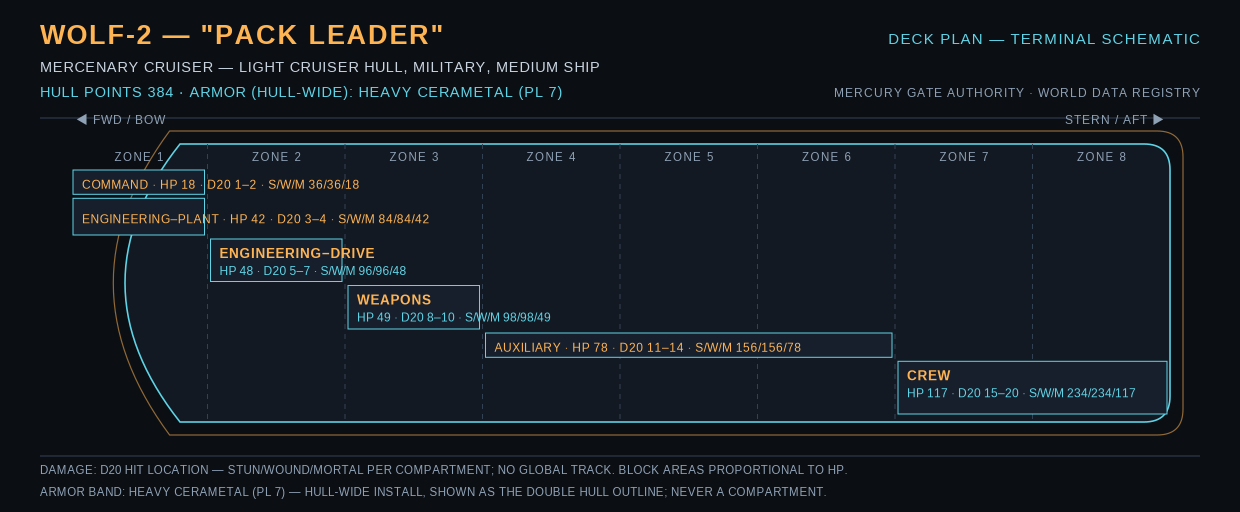
Damage (compartment model): roll d20 — 1-2 Command (36/36/18), 3-4 Engineering–Plant (84/84/42), 5-7 Engineering–Drive (96/96/48), 8-10 Weapons (98/98/49), 11-14 Auxiliary (156/156/78), 15-20 Crew (234/234/117). Stun/Wound/Mortal per section; section durability is the section's hull points, whole throughout (compartment total 352, +32 armor = 384 — her whole hull, counted the compartment system's way).
Hull Cost: $50 M Total Fitted Cost: $125.43 M (see tally — two and a half times the bare hull. A Pack Leader is not bought; she is capitalized, the way a small war is capitalized, and her day rate is a line in campaign budgets on both sides of the contract)
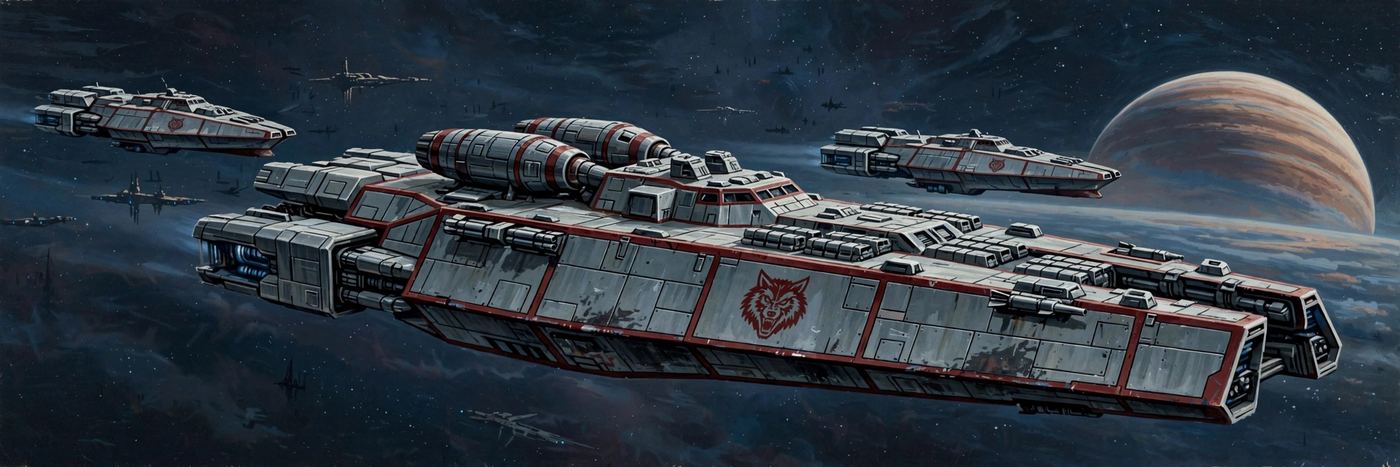
Armor: Heavy Cerametal (PL 7, Military availability) — 10% of hull = 32 HP — d8 LI / d8 HI / d8 En — $12,800 K (priced per durability point, Starships Table S21; the Warships table, W p.59, agrees at the heavy grade: $400 K a point). Chosen under Joseph's armor rule: a Pack Leader arrives to change a campaign's stakes and expects to be shot at by fleets, from whatever bearing the campaign gives her, so she wears the heaviest balanced plate her class can carry. The plate is also part of the silhouette, and the silhouette is part of the advertisement: everyone in Sol knows what 32 points of cerametal means before she has spoken a word.
Power Core: Mass Reactors (PL 7) x2, 20 HP each = 40 HP — 140 power points — no fuel required (Table 5-3, W p.60). Two plants, either of which runs the ship's house load alone: a Pack Leader's contracts do not include a clause for going dark.
Propulsion: Induction Engines (PL 7) x2, 24 HP each = 48 HP = 15% of hull — Acceleration 3 Mpp — no fuel, no exhaust (Table 5-4, W p.62). A medium ship that moves like a light one: Pack Leaders do not patrol, and the drive fit is why their arrivals read as decisions rather than schedules.
Endurance: 44,400 store-days = 185 days at her full complement of 240 (basic allotment follows the berths, plus Deep Stores, W p.70) — two gate cycles of campaigning with a company embarked, because a mercenary cruiser's endurance is measured in other people's wars, and wars do not keep gate hours.
Compartments
COMPARTMENTS (HP / Power / Cost per system; zones per Table 5-18, W p.103 — Light cruiser: 8 zones, zone limit 75 HP)
| Compartment | Zones | HP | d20 | S / W / M |
|---|---|---|---|---|
| Command | Zone 1 | 18 | 1–2 | 36/36/18 |
| Engineering–Plant | Zone 1 | 42 | 3–4 | 84/84/42 |
| Engineering–Drive | Zone 2 | 48 | 5–7 | 96/96/48 |
| Weapons | Zone 3 | 49 | 8–10 | 98/98/49 |
| Auxiliary | Zones 4, 5, 6 | 78 | 11–14 | 156/156/78 |
| Crew | Zones 7, 8 | 117 | 15–20 | 234/234/117 |
Installed Systems
1. Command — ZONE 1 (18 HP / 12 pw / $9,020 K) — fleet coordination and the intelligence division
| System | HP | Power | Cost | Notes |
|---|---|---|---|---|
| Command Deck | 2 | 0 pw | $600 K | (six stations; airlock included — the working bridge, run quiet and procedural, like every Wolf bridge: the pack does its shouting in the broadcast suite, below) |
| Flag Bridge | 4 | 0 pw | $1,200 K | (the fleet coordination deck, priced at the scaled command rate of the book's worked example, as the Keystone's control floor was: coordination plot, contract dais, and the liaison gallery where a client's staff watch their war being run. A Pack Leader is usually the largest Wolf hull on a contract that does not rate the Fang, and this deck is where that seniority sits) |
| Computer Core, Good | 2 | 2 pw | $2,000 K | the operations core (Table 5-14a, W p.91) |
| Computer Core, Good | 2 | 2 pw | $2,000 K | the intelligence division's core, kept apart from operations so that no failure — and no client — can reach both at once: target folders, contract intelligence, and the division's own sources, which are Wolf property and are not part of any contract's deliverables |
| Fire Control, Ordinary x3 | 3 | 0 pw | $3,000 K | (one dedicated to each maser battery and one to the missile racks; -1 step bonus to their attack rolls — costed per hull point of the dedicated system, Table 5-14a, W p.91) |
| Radio Transceiver x4 sets | 2 | 4 pw | $100 K | (redundant comms in depth: fleet broadcast, contract channels, and the liaison net. A Pack Leader is a headquarters that moves, and a headquarters is mostly radios) |
| EM Detector x2 sets | 1 | 0 pw | $40 K | (passive, 10/20/60 Mm, all four arcs between the two sets — Military-availability sensors under Wolf registry) |
| Air/Space Radar x4 sets | 2 | 4 pw | $80 K | (active, 5/10/20 Mm, all four arcs: a fleet flagship does not have a blind side, because the fleet is watching hers) |
Hit effect: sensors and comms die early in the zone's damage order; the cores are the last things in here still thinking, and they are duplicated precisely so that losing one is a report, not a decapitation.
2. Engineering–Plant — ZONE 1 (42 HP) — twin plants
| System | HP | Power | Cost | Notes |
|---|---|---|---|---|
| Mass Reactor x2 | 20 each | generate 70 pw | — | each / $7,000 K each |
| Accumulator x2 | 2 | 0 pw | $80 K | (store 10 power points each, Table 5-17 — the maser batteries' first salvo rides in them, charged and waiting, on every approach) |
Hit effect: the reactor compartment — if it loses its last mortal point, roll the base 1-in-6 reactor breach. Short of that, the plants fail one at a time and the ship fights on the survivor: the redundancy is not a luxury, it is the contract.
Zone 1 total: Command 18 + Plant 42 = 60 HP (limit 75).
3. Engineering–Drive — ZONE 2 (48 HP)
| System | HP | Power | Cost | Notes |
|---|---|---|---|---|
| Induction Engine (port) | 24 | draws 24 pw | $13,000 K | |
| Induction Engine (starboard) | 24 | draws 24 pw | $13,000 K |
Hit effect: the twin fit collects — one engine is a wound, not a kill. She finishes the campaign on the other, at reduced acceleration, and the contract's movement clauses have a schedule for exactly that, written in advance, in triplicate.
4. Weapons — ZONE 3 (49 HP / 24 pw / $5,640 K) — the full cruiser fit
| System | HP | Power | Cost | Notes |
|---|---|---|---|---|
| Maser (PL 7) in Turret x6 | 5 | 3 pw | $500 K | each — Acc -3, Range 1/2/4 Mm, En/S, Damage d6+2w / d4+1m / d6+1m, Mode F; the turrets bear on three arcs each, in two batteries of three (Tables 5-7/5-8, W pp.71/73) — see Design Notes on the masers |
| CHE Missile Rack x6 | 2 | 1 pw | $270 K | each — Acc 0, En/L, Damage d6+1s / d6+1w / d4+2m, Mode F (4 per round); reloads in port (Table 5-10, W p.80) |
| Point Defense Gun in Turret x4 | 1.25 | 0 pw | $250 K | each — Acc -1, Range 1/2/3 Mm, HI/Gd, Damage d4s / d4w / d4+2w, Mode F/B/A (Table 5-9, W p.75). Restricted availability in the civilian catalog; a cruiser wears them the way she wears her plate — as a statement about the threat she expects, made in hardware |
| Boarding Airlock x2 | 1 | 0 pw | $10 K | each (reinforced, with extendable tubes and cutting collars — her embarked company goes across through these, and a Pack Leader's boarding parties are not a tactic, they are a battalion with a door) |
Hit effect: weapons are first in every zone's damage order — a cruiser expects to bleed from here, and 32 points of cerametal are proof against the approach this compartment invites.
5. Auxiliary — ZONES 4, 5 and 6 (78 HP / 25 pw / $3,950 K) — the divisions' deck
| System | HP | Power | Cost | Notes |
|---|---|---|---|---|
| Damage Control (PL 6) | 16 | 16 pw | $1,600 K | 5% of hull, distributed fit: -2 step bonus to all damage checks (Table 5-13, W p.87). Military availability; at cruiser scale her damage parties are a standing department with its own watch rotation (ZONE 4, nominally — the fit is distributed, as the book describes it) |
| Broadcast Suite | 4 | 4 pw | $400 K | the propaganda division's studio: transmitters, holo projectors, and the editing core where Wolf's version of events is produced (priced as the dedicated comms installation she is, because the book has no line for a studio: Wolf's broadcasts from a Pack Leader reach every hull in the lane, and their production values are a weapon system in everything but table) (ZONE 4) |
| Fabrication Facility | 4 | 2 pw | $200 K | (Table 5-17, W p.98 — the logistics division's bench: she prints her own spares, her own boarding charges, and, on long contracts, her own reputation for never waiting on a supply ship) (ZONE 4) |
| Workshop x3 | 6 | 3 pw | $60 K | (ZONE 4) |
| Cargo Space | 10 | 0 pw | $100 K | (contract logistics: the client's supplies, the company's field kit, and the bonded stores that travel under Wolf seal) (ZONE 4) |
| Hangar | 24 | 0 pw | $900 K | (per hull point of craft capacity, Table 5-17 — assault boats, liaison shuttles, and the covert-operations division's insertion craft; the craft themselves are bought on their own sheets) (ZONE 5) |
| Docking Clamps | 2 | 0 pw | $50 K | rated to 10 hull points of craft outright, and hardpoints for taking a struck consort under tow by cable (ZONE 5) |
| Secure Hold | 4 | 0 pw | $40 K | (cargo-priced sealed stowage — the covert-operations bay's strongroom: what the division brings aboard, and what it brings back, manifests here, under a seal even the client does not break) (ZONE 5) |
| Sick Bay x4 | 8 | 0 pw | $600 K | (16 beds — the fleet hospital of a one-ship fleet: company casualties, client casualties, and, on the record's best days, the other side's) (ZONE 6) |
Hit effect: lose pieces of this compartment and she is still a cruiser, but she stops being a campaign — the divisions are why a Pack Leader is hired whole, and damage here is measured in capabilities struck off the contract, one by one.
Zone totals: Zone 4 = Damage Control 16 + Broadcast 4 + Fabrication 4 + Workshops 6 + Cargo 10 = 40 HP. Zone 5 = Hangar 24 + Clamps 2 + Secure Hold 4 = 30 HP. Zone 6 = Sick Bays 8 HP (the Auxiliary share of the zone).
6. Crew — ZONES 7 and 8 (117 HP / 10 pw / $3,940 K)
| System | HP | Power | Cost | Notes |
|---|---|---|---|---|
| Autosupport Unit x10 | 10 | 10 pw | $2,000 K | (full-ship life support; one unit covers 40 HP and she counts 384 — ten units cover 400, in banks, any deck of which can be isolated and still breathe) |
| Crew Quarters x20 | 40 | 0 pw | $400 K | (berths 120; galley rides in the first — the ship's company: bridge, engineering, gunnery, damage parties, and the divisions' uniformed staff) |
| Cabin x12 | 12 | 0 pw | $240 K | (berths 24 — the captain's, the flag staff's, the division heads', and the embarked company commander's: when Alpha Company 2/7 SIN is embarked, Captain Dale Sullivan's cabin is here, first in the row after the captain's own, which is Wolf's whole doctrine of the client rendered as furniture) |
| Crew or Troop Bunkroom x5 | 15 | 0 pw | $200 K | (berthing for 100, Table 5-6, W p.68 — the embarked company: Alpha Company 2/7 SIN, Captain Sullivan's own, rides a Pack Leader when Wolf means it. Their armoury rides in the first bunkroom's lockers, their liaison officer rides on the flag bridge, and their presence is the loudest line in the ship's manifest) |
| Escape Pod x20 | 20 | 0 pw | $1,000 K | (10-man capacity each: 200 seats for a complement of 240 — the remaining forty are the hangar watch and the boat crews, who leave in her craft, on the Keystone's arithmetic: a ship that is never alone does not pod her whole company, she launches them) (ZONE 8) |
| Deep Stores x20 | 20 | 0 pw | $100 K | (+20,000 store-days) (ZONE 8) |
Hit effect: life support margins shrink in banks; a Pack Leader's crew compartment is a barracks, a headquarters and a small town with a flag, and damage here is measured in companies.
Zone totals: Zone 7 = Autosupport 10 + Quarters 40 + Cabins 12 = 62 HP (limit 75). Zone 8 = Bunkrooms 15 + Pods 20 + Deep Stores 20 = 55 HP. Armor (32 HP) is a hull-wide percentage installation and is not zoned.
Budget Tally
Hull points: Armor 32 + Command 18 + Plant 42 + Drive 48 + Weapons 49 + Auxiliary 78 + Crew 117 = 384 spent / 384 available (320 base + 64 economy-of-scale). The design closes exactly — a Wolf ledger balances to the point, because the client is paying for the points and Wolf itemises. The itemising is not pedantry. It is the product.
Power: reactor output 140. Demand: Induction 48 + Maser 18 + Missile Racks 6 + Computer Cores 4 + Radios 4 + Radars 4 + Damage Control 16 + Broadcast Suite 4 + Fabrication 2 + Workshops 3 + Autosupport 10 = 119. Spare: 21 — the fleet margin, on paper: she runs everything at once, keeps a battery's first salvo in her accumulators, and has power left to lend a consort through the clamps. Where the spare goes on a bad day is written into the contract in advance, which is the most Wolf sentence in this file.
Cost: Hull $50,000 K + Armor $12,800 K + Command $9,020 K + Reactors $14,000 K + Accumulators $80 K + Induction $26,000 K + Weapons $5,640 K + Auxiliary $3,950 K + Crew $3,940 K = $125,430 K ($125.43 M).
Design Notes
(compromises, stated rather than fudged)
In Play
Wolf Corp's argument, in hull form. Pack Leaders do not patrol; they arrive. A campaign that puts one in orbit has changed its own stakes, and the GM should treat it that way. Run her arrival as a diplomatic event with a drive signature: the broadcast on every channel in the lane, the liaison's courtesy call, the embarked company's colours in the hangar when the client's shuttle docks. The players should learn that the most consequential sentence in a campaign is spoken before any shot: "Wolf Corp has accepted the contract."
Deck Plan — Terminal Schematic
Drawn from the sheet: compartment blocks sized by HP share, zones forward to aft, armor as the hull-wide outline band. Damage is rolled per compartment — there is no global track.