UTE-2 — Keystone
UTE-2 "KEYSTONE" (Unified Terran Empire Gate Tender / Construction Ship, imperial)
FACTION FILE: UNIFIED TERRAN EMPIRE
Summary
Harbour of the Gate (the UTE doctrine at scale: anything at the Mercury Array is inside her reach — her drydock arms, her hospital, her hangars, her archive, and her spare power, which she lends to docked ships as a utility of the port. A ship in trouble at the gate is not near help; she is inside it. Whoever holds a Keystone holds a gate window, and the holding is done with paperwork, spare parts, and soup)
She Cannot Leave (By the Book, at the scale of infrastructure: Acceleration 1 and Maneuver Class 0 are the least of it — a Keystone's duty is a place, and the place is the gate. If she ever leaves her station, the Array is untended, the window is unwitnessed, and the Empire's whole settlement has a hole in it shaped exactly like her. Her captains do not command a ship so much as succeed to an office; relief is a ceremony, and it has never once been hurried)
Particulars
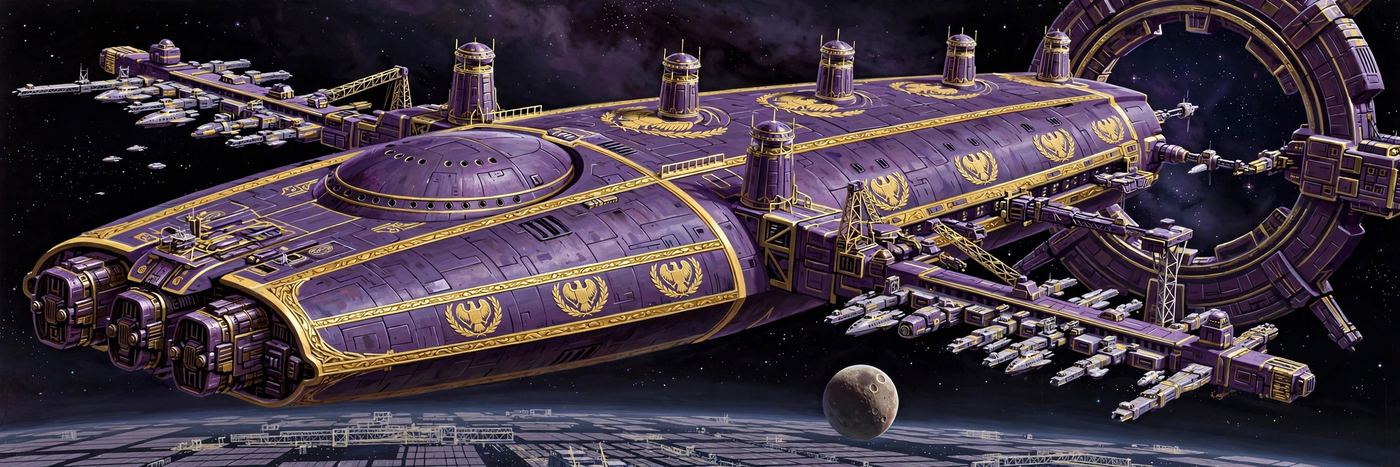
Class: Gate Tender / Construction Ship on a Super-freighter hull, imperial — heavy ship (Table 5-1b, W p.55). The Ships pack calls the type "super-freighter-derived, civilian/imperial"; the hull form is the civilian super-freighter, and everything above the hull form is the Gate Authority. This is the class of the massive construction ship sent through ahead of the 2245 rush, and of the tenders that have kept the Array alive at Mercury ever since.
Hull Points: 2,400 + 1,200 economy-of-scale bonus = 3,600 (percentages figured on the base 2,400, per W p.57)
Toughness: Hv (Heavy) Target Modifier: -3 steps
Maneuver Class: 0 Crew: 300 (book standard crew); her working complement runs to 800 in three rotations — Gate Authority control staff, reactor and dock crews, hospital, registry clerks, and the inspection parties between Heralds (see Crew) Designation, stated plainly: she is an imperial hull on the Gate Authority register — a military registry, whatever her hull's civilian ancestry — and the restriction audit's rule is applied to her on that basis. In the event, the argument is nearly academic: the only Military-availability systems aboard are her EM sensor sets, carried under imperial warrant, and she mounts no weapons at all. The Empire's most important ship is unarmed, and that is not an oversight. It is the settlement the gate stands on — see Design Notes.
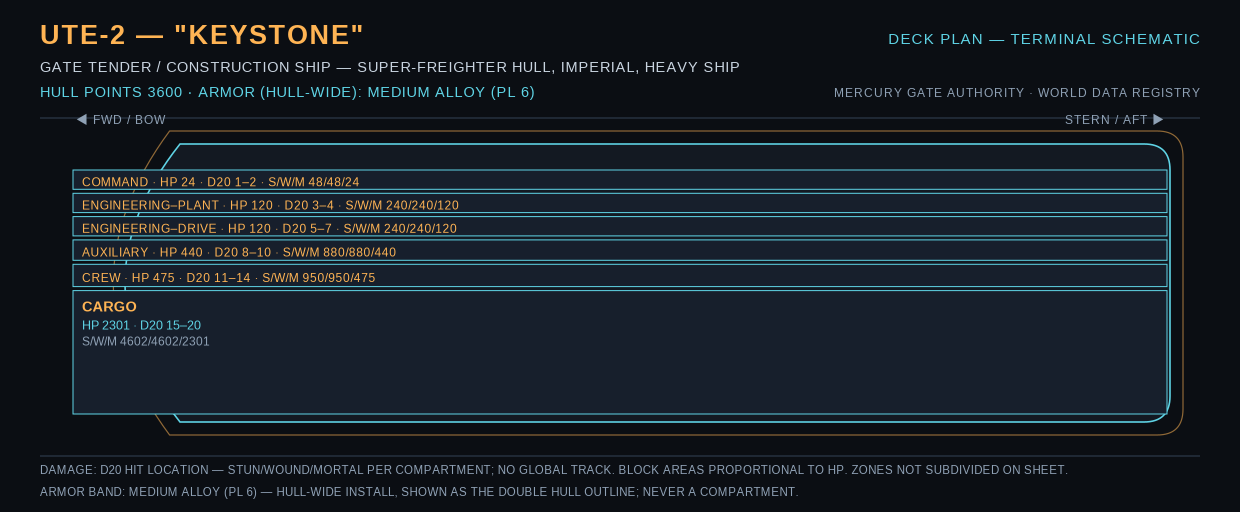
Damage (compartment model): roll d20 — 1-2 Command (48/48/24), 3-4 Engineering–Plant (240/240/120), 5-7 Engineering–Drive (240/240/120), 8-10 Auxiliary (880/880/440), 11-14 Crew (950/950/475), 15-20 Cargo (4602/4602/2301). Stun/Wound/Mortal per section; section durability is the section's hull points, whole throughout (compartment total 3,480, +120 armor = 3,600 — her whole hull, counted the compartment system's way).
Hull Cost: $400 M Total Fitted Cost: $627.07 M (see tally — the bare hull is two-thirds of her price, which is the super-freighter's own arithmetic; what the Empire adds is a reactor farm, a drydock, a hospital, an archive, and eight hundred people's worth of life)
Armor: Medium Alloy (PL 6, Controlled availability) — 5% of hull = 120 HP — d4+1 LI / d4+1 HI / d4 En — $54 M (priced per durability point, Starships Table S21: $150 K per 10 durability across her 3,600). Chosen under Joseph's armor rule: a Keystone cannot run, cannot dodge, and holds the one window every faction in Sol needs open — if she is ever shot at, it will be from whatever bearing the shooter chooses, so she wears the balanced plate with no weak face; and alloy, because she is maintained by her own dock crews at Mercury, forever, and alloy is the plate a ship can patch with what she herself carries. Her real armor is the Herald screen and the law; the plate is for the day both are late.
Power Core: Mass Reactors (PL 7) x4, 30 HP each = 120 HP — 420 power points — no fuel required (Table 5-3, W p.60). A reactor farm, not a plant: any one reactor can be cold for maintenance while the Array never notices.
Propulsion: Induction Engines (PL 7) x2, 60 HP each = 120 HP = 5% of hull — Acceleration 1 Mpp — no fuel, no exhaust (Table 5-4, W p.62). She does not travel; she repositions — between Array anchor points, over days, with tugs in attendance and the gate schedule reprinted around her.
Endurance: 180,000 store-days = 225 days at her full complement of 800 (basic allotment 80,000 follows the berths, plus Deep Stores, W p.70) — two and a half gate cycles with every berth filled, because a tender that keeps the gate also keeps the gate's rescue stock, and her endurance is measured in other ships' emergencies as well as her own.
Compartments
COMPARTMENTS (HP / Power / Cost per system; zones — Table 5-18's super-heavy rows do not extract from the scan; see Design Notes. Systems are listed by compartment, which is the damage model the sheets use)
| Compartment | Zones | HP | d20 | S / W / M |
|---|---|---|---|---|
| Command | — | 24 | 1–2 | 48/48/24 |
| Engineering–Plant | — | 120 | 3–4 | 240/240/120 |
| Engineering–Drive | — | 120 | 5–7 | 240/240/120 |
| Auxiliary | — | 440 | 8–10 | 880/880/440 |
| Crew | — | 475 | 11–14 | 950/950/475 |
| Cargo | — | 2301 | 15–20 | 4602/4602/2301 |
Installed Systems
1. Command (24 HP / 16 pw / $7,960 K) — Gate Authority control
| System | HP | Power | Cost | Notes |
|---|---|---|---|---|
| Gate Authority Control Deck | 12 | 0 pw | $3,600 K | (the command deck rate of the book's worked example, W pp.103-107, scaled to a control floor: gate plot, Array plot, traffic plot, and the registry dais where windows are granted — a bridge built like a harbourmaster's office because it is one) |
| Computer Core, Good | 2 | 2 pw | $2,000 K | the operations core (Table 5-14a, W p.91) |
| Computer Core, Good | 2 | 2 pw | $2,000 K | the registry core: every hull, manifest, claim and window at the gate, kept apart from operations so that no failure — and no order — can reach both at once. The fortress of paperwork has two walls, and this is the inner one |
| Radio Transceivers x8 sets | 4 | 8 pw | $200 K | light-speed radio and laser relay, in depth: the Gate Authority's voice reaches the inner system on a relay chain of repeaters and Herald pickets. There is no faster voice. The Empire's answer to the lightspeed lag is not technology; it is procedure, written down in advance for every case the lag can create |
| EM Detectors x4 sets | 2 | 0 pw | $80 K | (passive, all four arcs — Military-availability sensors under imperial warrant: the tender watches the whole sky around the gate and writes down everything she sees) |
| Air/Space Radars x4 sets | 2 | 4 pw | $80 K | (active, all four arcs — traffic control for the busiest anchorage in Sol) |
Hit effect: the control floor is the most sheltered compartment in the ship and the one she can least spare; a Keystone that loses Command still floats, still breathes, still holds eight hundred people — and the gate has no witness, which at Mercury is a kind of sinking.
2. Engineering–Plant (120 HP) — the reactor farm
| System | HP | Power | Cost | Notes |
|---|---|---|---|---|
| Mass Reactor x4 | 30 each | generate 420 pw | $38,000 K | (each: $2 M install + $250 K per hull point, Table 5-3, W p.60 — the book's own worked-example pricing, at farm scale) |
Hit effect: the reactor compartment — sections of the farm fail one reactor at a time, and the farm is sized so that three carry the ship and the Array's house load together. If the compartment loses its last mortal point, roll the base 1-in-6 reactor breach — four times over, in a ship that is also the gate's lifeboat, which is why the farm is tended like a chapel and insured like a city.
3. Engineering–Drive (120 HP)
| System | HP | Power | Cost | Notes |
|---|---|---|---|---|
| Induction Engine x2 | 60 each | draw 120 pw | $62,000 K | (each: $1 M install + $500 K per hull point, Table 5-4, W p.62) |
Hit effect: she stops repositioning. Nothing else about her changes, which is the most honest hit effect in this file: a Keystone under way and a Keystone adrift are the same port, in slightly different places, and only one of them is where the gate needs her to be.
4. Auxiliary (440 HP / 90 pw / $19,400 K) — drydock, hospital, archive
| System | HP | Power | Cost | Notes |
|---|---|---|---|---|
| Drydock Assembly | 100 | 40 pw | $4,500 K | fabrication facilities x20 (4 HP / 2 pw / $200 K each, Table 5-17, W p.98) arranged as gantry lines along two docking spines, with docking and gantry clamps x10 (2 HP / $50 K each) rated for work alongside: she rebuilds Array components, patches hulls up to light-ship class, and prints the spares her own cargo manifests promise. Capital work still goes to the Luna yards; the Keystone is the yard that is already there |
| Hangars | 240 | 0 pw | $9,000 K | (per hull point of craft capacity, Table 5-17 — her launches, work pods, inspection craft and rescue boats, and berthing for a Herald on station relief; the craft themselves are bought on their own sheets) |
| Sick Bay x10 | 20 | 0 pw | $1,500 K | (40 beds — the gate hospital: decompression, radiation, and whatever the far side sends back, in that order, every 88 days) |
| Registry Archive | 20 | 0 pw | $200 K | (priced as cargo space, because the book has no line for a library that is also a court: the paper and crystal record of every crossing since 2245, massed deep in the hull where fire reaches last) |
| Workshops x10 | 20 | 10 pw | $200 K | (the maintenance shops of the Array gangs — the men and women who keep the ring alive berth in Crew and work here, and their benches are fitted for Array hardware, not ship's stores) |
| Damage Control (PL 6) | 40 | 40 pw | $4,000 K | distributed fit: -2 step bonus to all damage checks (Table 5-13, W p.87). Military availability; an imperial hull carries it as a matter of course, at infrastructure scale — her damage parties are a standing department with its own berths in Crew and its own line in the gate budget |
Hit effect: lose this compartment and she is still a port, but she stops being a promise — the dock, the hospital and the archive are why ships limp to Mercury instead of dying in the dark, and the archive's loss would be the only one the Empire could never reprint.
5. Crew (475 HP / 90 pw / $22,700 K) — station rotation berthing
| System | HP | Power | Cost | Notes |
|---|---|---|---|---|
| Autosupport Units x90 | 90 | 90 pw | $18,000 K | (full-ship life support; one unit covers 40 HP and she counts 3,600 — ninety units, in banks, any deck of which can be isolated and still breathe) |
| Crew Quarters x100 | 200 | 0 pw | $2,000 K | (berths 600, at the book's quarters rate — the standing complement: control staff, reactor and dock crews, damage parties, Array gangs) |
| Cabins x50 | 50 | 0 pw | $1,000 K | (berths 100 — department heads, surgeons, the Registrar's clerks of court grade, and the captain's office-cabin, from which the gate is administered) |
| Crew or Troop Bunkrooms x5 | 15 | 0 pw | $200 K | (berths 100, Table 5-6, W p.68 — the rotation deck: reliefs in transit, inspection parties between Heralds, and passengers of the Empire's necessity, who are carried on the Empire's paper and berthed on the Empire's terms) |
| Escape Pods x20 | 20 | 0 pw | $1,000 K | (10-man capacity each: 200 seats — the duty watch and the hospital. The rest of her people evacuate in her boats and her docked charges; see Design Notes) |
| Deep Stores | 100 | 0 pw | $500 K | (+100,000 store-days — the rescue stock rides here as well as in Cargo: food, air, water and medical stores for ships that arrive at the gate in no condition to ask politely) |
Hit effect: life support margins shrink in banks, not all at once; a Keystone's crew compartment is a small city with a harbour attached, and damage here is measured in neighbourhoods.
6. Cargo (2,301 HP / 0 pw / $23,010 K) — construction, spares, rescue stock
| System | HP | Power | Cost | Notes |
|---|---|---|---|---|
| Cargo Space | 2,301 | 0 pw | $23,010 K | 2,301 cargo units (Array components and construction stock for the ring's endless maintenance; reactor and drive spares up to light-ship class; containerised rescue stock — air, water, food, medical — manifested separately from Deep Stores because it is not hers: it belongs to whoever comes through the gate needing it, and the registry core in Command holds the list) |
Hit effect: depends on the load; cargo is the ship's ablative honesty — on a Keystone, it is also the gate's warehouse, and a fire here burns next year's Array and somebody else's rescue, in whichever order the manifest reads.
Budget Tally
Hull points: Armor 120 + Command 24 + Plant 120 + Drive 120 + Auxiliary 440 + Crew 475 + Cargo 2,301 = 3,600 spent / 3,600 available (2,400 base + 1,200 economy-of-scale). The design closes exactly — the Empire's largest ledger balances to the point, which is either the Empire's virtue or its whole personality, depending on which faction is reading.
Power: reactor farm output 420. Demand: Induction 120 + Autosupport 90 + Damage Control 40 + Drydock 40 + Workshops 10 + Computer Cores 4 + Radios 8 + Radars 4 = 316. Spare: 104 — the port's margin, on paper: she powers docked ships, runs the Array's house load in a pinch, and keeps a hundred points between the gate and the dark. Where the spare goes on a bad day is a question the gate schedule answers in advance.
Cost: Hull $400,000 K + Armor $54,000 K + Command $7,960 K + Reactors $38,000 K + Induction $62,000 K + Auxiliary $19,400 K + Crew $22,700 K + Cargo $23,010 K = $627,070 K ($627.07 M).
Design Notes
(compromises, stated rather than fudged)
In Play
a port, a shipyard, and a fortress of paperwork. Whoever holds a Keystone holds a gate window. Run her as the fixed point of the Mercury game: every faction's agents walk her decks, her Registrar's clerks stamp every crossing, her hospital takes every faction's casualties without asking their registry, and her archive remembers everything. The adventure is never the Keystone herself — she does not move, in any sense — it is what eight hundred people from six flags are doing aboard her while the window counts down.
Deck Plan — Terminal Schematic
Drawn from the sheet: compartment blocks sized by HP share, zones forward to aft, armor as the hull-wide outline band. Damage is rolled per compartment — there is no global track.