TPA-1 — Ledger
TPA-1 "LEDGER" (Trans Progressive Atomic Medium Transport / Powered Infantry Carrier, civilian)
FACTION FILE: TRANS PROGRESSIVE ATOMIC
Summary
Clean Manifest (the TPA doctrine made a fit: every compartment aboard is exactly where the registry says it is, every system is legal, and she has passed imperial inspection without annotation — her paperwork is a defensive system, maintained like one, by a core whose second job is keeping the accounts true)
Second Cargo (the TPA doctrine flaw, built into the class: her hold measures half a unit larger than her registry declares, and her plant carries three points of power nobody accounted for — the space, the power margin, and the paperwork for a cargo that is not on the manifest are not modifications. They are the design. Inspectors in 2250 are starting to design for that assumption; see the Ships pack)
Particulars
Class: Medium Transport / Powered Infantry Carrier on a Fast Transport hull, civilian — small craft (Table 5-1b, W p.55). The Ships pack labels her "military-civilian crossover"; the Fast Transport is a civilian hull type, and the crossover is in her paperwork and her passenger list, not her registry — see Designation.
Hull Points: 40 (small craft: no economy-of-scale bonus)
Toughness: Sm (Small) Target Modifier: +2 steps
Maneuver Class: 4 Crew: 10 (book standard crew) Designation, stated plainly: she is a civilian hull on a civilian registry, and the civilian restriction applies to her in full — every system aboard is Common or Controlled availability. The restriction audit (reference S.19.4) flagged exactly this ship: the "crossover" label does not change a hull's designation, and anything military added at the table falls under civilian procurement rules. TPA's answer is that she needs nothing military. Her soldiers are passengers until the ramps open; her weapon is her manifest. The military fact about a Ledger is not in her fit. It is in her orders.
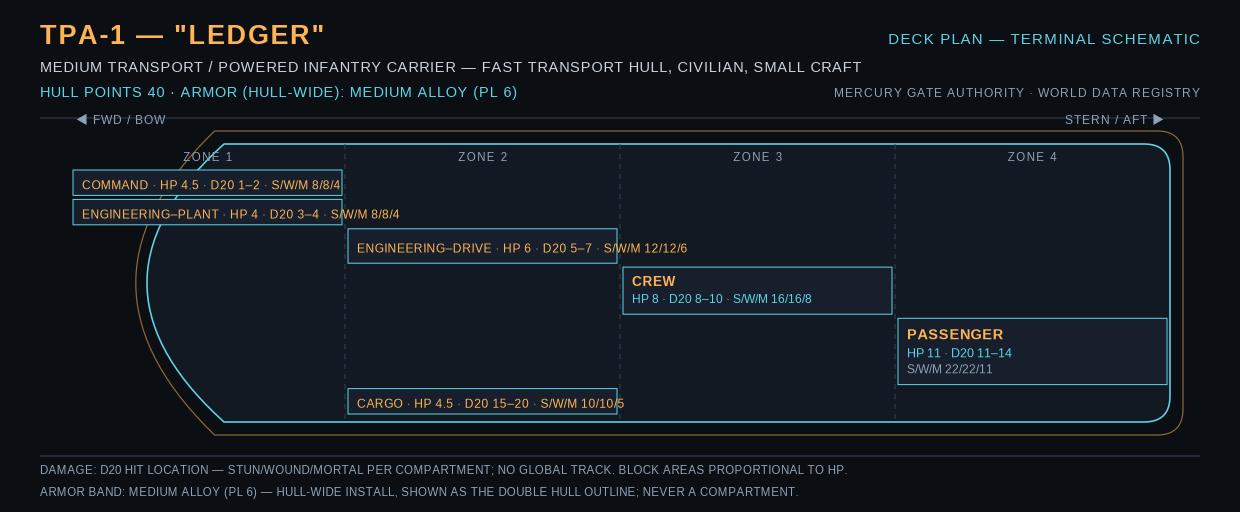
Damage (compartment model): roll d20 — 1-2 Command (8/8/4), 3-4 Engineering–Plant (8/8/4), 5-7 Engineering–Drive (12/12/6), 8-10 Crew (16/16/8), 11-14 Passenger (22/22/11), 15-20 Cargo (10/10/5). Stun/Wound/Mortal per section; section durability pooled to whole points (Command 4, Plant 4, Drive 6, Crew 8, Passenger 11, Cargo 5; compartment total 38, +2 armor = 40 — her whole hull, counted the compartment system's way; the Command and Cargo half points pool against each other and cancel).
Hull Cost: $800 K Total Fitted Cost: $10.065 M (see tally — twelve and a half times the bare hull; on a Ledger the money is the drive, the plant, and the paperwork made metal: a command deck and a core to keep the accounts in)
Armor: Medium Alloy (PL 6, Controlled availability) — 5% of hull = 2 HP — d4+1 LI / d4+1 HI / d4 En — $600 K (priced per durability point, Starships Table S21: $150 K per 10 durability across her 40). Chosen under Joseph's armor rule: a Ledger takes whatever run TPA pays for, in whatever weather the Mars lane serves, so she wears the balanced plate with no weak face — and alloy, because she has to be patchable at both ends of her run, and one of those ends does not officially exist. Reactive plate wants a TPA yard; alloy wants a welder and a day rate, and the rebellion has welders.
Power Core: Mass Reactor (PL 7), 4 HP — 14 power points — no fuel required (Table 5-3, W p.60)
Propulsion: Induction Engine (PL 7), 6 HP = 15% of hull — Acceleration 3 Mpp — no fuel, no exhaust (Table 5-4, W p.62). She is a fast hull driven like one: TPA sells schedule, and a Ledger's unofficial schedule is the one that matters.
Endurance: 8,400 store-days = 120 days at her full manifest of seventy souls (basic allotment 7,400 follows the berths, plus Deep Stores, W p.70) — a full gate cycle with the company embarked, and the Mars run inside it twice over.
Compartments
COMPARTMENTS (HP / Power / Cost per system; zones per Table 5-18, W p.103 — Fast Transport: 4 zones, zone limit 14 HP)
| Compartment | Zones | HP | d20 | S / W / M |
|---|---|---|---|---|
| Command | Zone 1 | 4.5 | 1–2 | 8/8/4 |
| Engineering–Plant | Zone 1 | 4 | 3–4 | 8/8/4 |
| Engineering–Drive | Zone 2 | 6 | 5–7 | 12/12/6 |
| Crew | Zone 3 | 8 | 8–10 | 16/16/8 |
| Passenger | Zone 4 | 11 | 11–14 | 22/22/11 |
| Cargo | Zone 2 | 4.5 | 15–20 | 10/10/5 |
Installed Systems
1. Command — ZONE 1 (4.5 HP / 3 pw / $1,165 K)
| System | HP | Power | Cost | Notes |
|---|---|---|---|---|
| Command Deck | 2 | 0 pw | $600 K | (six stations; airlock included — the seventh presence on the deck is the purser's terminal, which is not a station but a ledger with a chair) |
| Computer Core, Ordinary | 1 | 1 pw | $500 K | the ship's second brain, and the reason for her name: it keeps the manifest, the accounts, and the maintenance log in triplicate, and it can produce any of them for an inspector in under a minute. What it keeps beyond that, it keeps the same way. |
| Radio Transceiver | 0.5 | 1 pw | $25 K | |
| Air/Space Radar | 0.5 | 1 pw | $20 K | (active, 5/10/20 Mm, 1 arc) |
| IR Detector | 0.5 | 0 pw | $20 K | (passive, 2/4/8 Mm, 1 arc — the legal civilian fit; the military EM detector does not ship on a civilian hull, not even one carrying an army) |
Hit effect: sensors and comms die early in the zone's damage order; the core is the last thing in here still thinking, and a Ledger that loses her core has lost her alibi — the accounts aboard are the cargo, whatever the hold says.
2. Engineering–Plant — ZONE 1 (4 HP)
| System | HP | Power | Cost | Notes |
|---|---|---|---|---|
| Mass Reactor | 4 | generates 14 pw | $3,000 K |
Hit effect: the reactor compartment — if it loses its last mortal point, roll the base 1-in-6 reactor breach. Short of that, she has power to spare and spends it like ballast: something else always fails first — and the spare three points are spoken for by a cargo that does not exist, officially.
Zone 1 total: Command 4.5 + Plant 4 = 8.5 HP.
3. Engineering–Drive — ZONE 2 (6 HP)
| System | HP | Power | Cost | Notes |
|---|---|---|---|---|
| Induction Engine | 6 | draws 6 pw | $4,000 K |
Hit effect: she stops going anywhere — and a Ledger that cannot run her schedule is a warehouse with a company aboard and a manifest that says she is somewhere else.
4. Crew — ZONE 3 (8 HP / 1 pw / $315 K)
| System | HP | Power | Cost | Notes |
|---|---|---|---|---|
| Autosupport Unit | 1 | 1 pw | $200 K | (full-ship life support; one unit covers 40 HP and she is exactly 40 — the company breathes inside the same envelope, on the same system, at the same rating; TPA fits life support the way it keeps books, to the number and no further) |
| Crew Quarters x2 | 4 | 0 pw | $40 K | (berths 12; galley rides in the first — crew of ten, and two berths kept for the company's officers, who berth on the crew side of the bulkhead as a courtesy and a surveillance arrangement in one) |
| Cabin | 1 | 0 pw | $20 K | (berths 2 — the captain and the purser, whose cabin is also the accounts office, and the only door on the ship that locks from both sides) |
| Escape Pod | 1 | 0 pw | $50 K | (10-man capacity — the crew, exactly; see Design Notes on the company's arrangements) |
| Deep Stores | 1 | 0 pw | $5 K | (+1,000 store-days) |
Hit effect: life support margins shrink; the galley is always the first thing the crew rigs back, and the purser's copy of the manifest is the second.
5. Passenger — ZONE 4 (11 HP / 1 pw / $140 K) — the company deck
| System | HP | Power | Cost | Notes |
|---|---|---|---|---|
| Crew or Troop Bunkroom x3 | 9 | 0 pw | $120 K | (berthing for 20 per bunkroom, Table 5-6, W p.68 — sixty powered infantry in three dormitories, fitted as suit racks as much as berths: every berth is a powered frame with suit power, restraint, and stowage for the trooper's kit, and the compartment's aft end is the drop lock and ramps, wide enough for armor at a run — the pack's drop-assist, fitted as furniture) |
| Workshop | 2 | 1 pw | $20 K | the suit maintenance bay: benches, hoists, and parts racks for sixty suits, sized to rebuild a squad's worth of armor between orbit and descent (priced as the book's workshop, because that is what the hull feels; the suits themselves are TPA issue, embarked with their owners, and not part of the ship's fit) |
Hit effect: the book's ordering puts the passenger compartment last and most exposed, and on a Ledger that means sixty soldiers in their racks ride in the compartment most likely to be hit. TPA's answer is in the design: the racks are the troopers' protection, and a soldier in a powered frame is the best-protected passenger in Sol. It is also the only protection the company gets — there is no pod arithmetic that includes them, and everyone aboard has read the same manifest about it.
6. Cargo — ZONE 2 (4.5 HP / 0 pw / $45 K)
| System | HP | Power | Cost | Notes |
|---|---|---|---|---|
| Cargo Space | 4.5 | 0 pw | $45 K | 4.5 cargo units (four units on the registry: company freight, TPA stores, and manifested trade goods. The hold measures four and a half. The half unit is not an error, a refit, or a rounding convention; it is framed, powered, and ventilated, and it appears on no document the ship carries. See Flaw) |
Hit effect: depends on the load; cargo is the ship's ablative honesty — on a Ledger, it is the one compartment where that sentence runs backwards.
Zone totals: Zone 2 = Drive 6 + Cargo 4.5 = 10.5 HP.
Zone 3 = Crew 8 HP. Zone 4 = Passenger 11 HP. Armor (2 HP) is a hull-wide percentage installation and is not zoned.
Budget Tally
Hull points: Armor 2 + Command 4.5 + Plant 4 + Drive 6 + Crew 8 + Passenger 11 + Cargo 4.5 = 40 spent / 40 available. The design closes exactly — a TPA ledger balances, to the point, on paper. That is the paper's job.
Power: reactor output 14. Demand: Induction 6 + Computer Core 1 + Radio 1 + Radar 1 + Autosupport 1 + Suit Workshop 1 = 11. Spare: 3 — the Second Cargo margin, on paper: enough to run a hold's worth of life support and climate for a cargo that is not on the manifest, for exactly as long as the manifest says the run takes.
Cost: Hull $800 K + Armor $600 K + Command $1,165 K + Reactor $3,000 K + Induction $4,000 K + Crew $315 K + Passenger $140 K + Cargo $45 K = $10,065 K ($10.065 M).
Design Notes
(compromises, stated rather than fudged)
In Play
TPA's honest workhorse — and the hull class that supplies a rebellion without ever, officially, going to Mars. Run her arrivals as accounting: the manifest is read, the accounts balance, the inspectors leave satisfied, and somewhere below the waterline of the paperwork a war is being supplied — itemized, insured, and entered in triplicate, because TPA's atomic-age optimism holds that anything worth doing is worth documenting. The players should learn to ask not what a Ledger carries, but what her hold measures.
Deck Plan — Terminal Schematic
Drawn from the sheet: compartment blocks sized by HP share, zones forward to aft, armor as the hull-wide outline band. Damage is rolled per compartment — there is no global track.