TOE-1 — Sermon
TOE-1 "SERMON" (Theocracy of Enlightenment Assault Dropship, military)
FACTION FILE: THEOCRACY OF ENLIGHTENMENT
Summary
Drops Like Judgement (the TOE doctrine made a fit: Acceleration 3 on a planetary-rated drive, missile racks that clear her own landing zone on the way down, and a hundred infantry out of the racks and off the ramps in one rehearsed motion — the descent checklist ends with the roll of the company, read aloud, and the ramps come down on the last name)
One-Way Manifest (the pack's flaw, literal on her hull: she is built to deliver people to a surface. Her escape pod seats her crew alone. The company has no berths, no galley, and no way off a bad landing except the ship herself — repaired, or not at all. The racks fly up as well as down, and everyone aboard understands the difference between the paper and the plan)
Particulars
Class: Assault Dropship on an Escort hull, military — small craft (Table 5-1a, W p.55). The Ships pack says "Escort-derived"; the Escort is the hull that carries her crew of 10, and the derivation is the drop fit.
Hull Points: 40 (small craft: no economy-of-scale bonus)
Toughness: Sm (Small) Target Modifier: +2 steps
Maneuver Class: 4 Crew: 10 (book standard crew) + the ship's chaplain in the eleventh berth — and a full infantry company in the drop compartment, who are not crew and do not berth; see Passenger
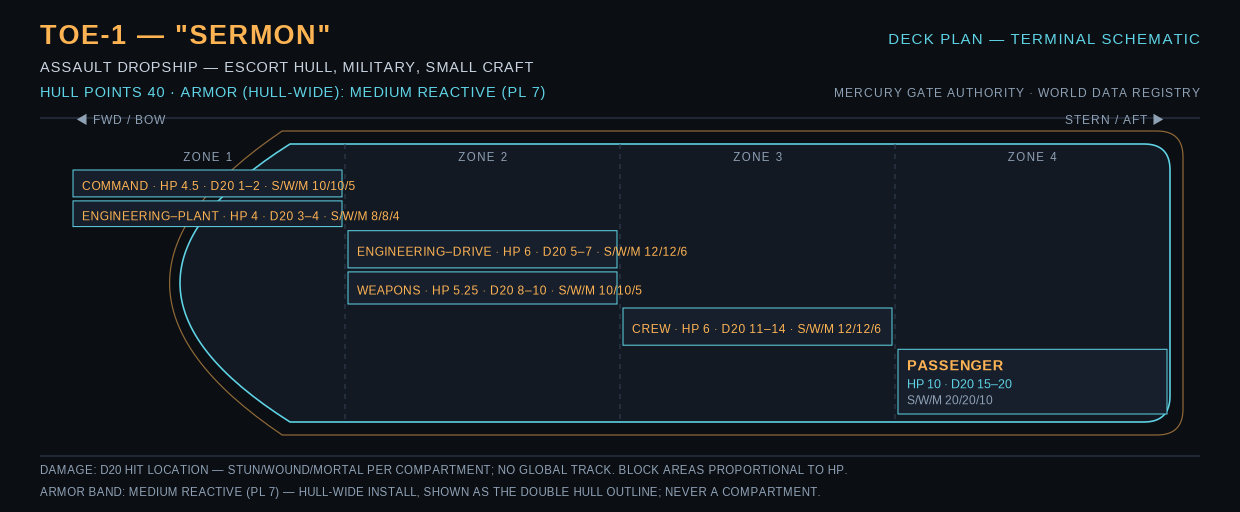
Damage (compartment model): roll d20 — 1-2 Command (10/10/5), 3-4 Engineering–Plant (8/8/4), 5-7 Engineering–Drive (12/12/6), 8-10 Weapons (10/10/5), 11-14 Crew (12/12/6), 15-20 Passenger (20/20/10). Stun/Wound/Mortal per section; section durability pooled to whole points (Command 5, Plant 4, Drive 6, Weapons 5, Crew 6, Passenger 10; compartment total 36, +2 armor, +2 for the distributed damage-control fit = 40 — her whole hull, counted the compartment system's way, against 35.75 built in sections — the fractions are the pooling).
Hull Cost: $1 M Total Fitted Cost: $10.895 M (see tally)
Armor: Medium Reactive (PL 7, Controlled availability) — 5% of hull = 2 HP — d4+2 LI / d6 HI / d4 En — $400 K (Table S21, S p.54 — priced per durability point, Joseph's ruling 2026-11-17). Chosen under Joseph's armor rule: a dropship's fire comes up at her, on the descent, and it is impact fire — flak and mass drivers — so she wears the plate that turns high impact best in the medium grades, bought to be blown off and replaced between drops. The energy face is the accepted weakness: beam weapons are a capital ship's argument, and a Sermon's argument is with the ground.
Power Core: Mass Reactor (PL 7), 4 HP — 14 power points — no fuel required (Table 5-3, W p.60). Sized to the manifest, not the wish list; see Design Notes.
Propulsion: Induction Engine (PL 7), 6 HP = 15% of hull — Acceleration 3 Mpp — no fuel, no exhaust (Table 5-4, W p.62). Planetary-rated, as the drive is (W p.64): she lands on the same drive she cruises on, which on a dropship is not a convenience — it is the whole maneuver.
Endurance: 1,200 store-days = 100 days at her crew-side complement of twelve (basic allotment follows the berths, W p.70). The company does not draw on it: a company embarks fed, carries seventy-two hours of rations in its own kit, and is a surface problem again long before stores matter. A Sermon stages from Mars orbit and TOE stations; she is a ferry to the ground, not a home.
Compartments
COMPARTMENTS (HP / Power / Cost per system; zones per Table 5-18, W p.103 — Escort: 4 zones, zone limit 14 HP)
| Compartment | Zones | HP | d20 | S / W / M |
|---|---|---|---|---|
| Command | Zone 1 | 4.5 | 1–2 | 10/10/5 |
| Engineering–Plant | Zone 1 | 4 | 3–4 | 8/8/4 |
| Engineering–Drive | Zone 2 | 6 | 5–7 | 12/12/6 |
| Weapons | Zone 2 | 5.25 | 8–10 | 10/10/5 |
| Crew | Zone 3 | 6 | 11–14 | 12/12/6 |
| Passenger | Zone 4 | 10 | 15–20 | 20/20/10 |
Installed Systems
1. Command — ZONE 1 (4.5 HP / 3 pw / $1,165 K)
| System | HP | Power | Cost | Notes |
|---|---|---|---|---|
| Command Deck | 2 | 0 pw | $600 K | (six stations; airlock included — the seventh presence on the deck during a descent is the dropmaster's console, which is not a station but a countdown) |
| Computer Core, Ordinary | 1 | 1 pw | $500 K | the ship's second brain; it keeps the descent plot, the company's roll, and the damage ledger in the same memory, in that order of precedence |
| Radio Transceiver | 0.5 | 1 pw | $25 K | |
| EM Detector | 0.5 | 0 pw | $20 K | (passive, 10/20/60 Mm, 2 arcs — a Military-availability sensor, and she is a military hull: these are the eyes that read a landing zone's welcome before the hull does) |
| Air/Space Radar | 0.5 | 1 pw | $20 K | (active, 5/10/20 Mm, 1 arc) |
Hit effect: sensors and comms die early in the zone's damage order; lose the core and the descent plot is a memory in the dropmaster's head.
2. Engineering–Plant — ZONE 1 (4 HP)
| System | HP | Power | Cost | Notes |
|---|---|---|---|---|
| Mass Reactor | 4 | generates 14 pw | $3,000 K |
Hit effect: the reactor compartment — if it loses its last mortal point, roll the base 1-in-6 reactor breach. Short of that, a hurt plant on a ship with no spare power is a published sequence of darkness: the descent order says what goes dark, in what order, and the crew has rehearsed it.
Zone 1 total: Command 4.5 + Plant 4 = 8.5 HP.
3. Engineering–Drive — ZONE 2 (6 HP)
| System | HP | Power | Cost | Notes |
|---|---|---|---|---|
| Induction Engine | 6 | draws 6 pw | $4,000 K |
Hit effect: she stops going anywhere — and a Sermon that cannot descend is a transport with a hundred infantry aboard and nowhere to put them, which the Theocracy counts as the worse failure.
4. Weapons — ZONE 2 (5.25 HP / 2 pw / $790 K)
| System | HP | Power | Cost | Notes |
|---|---|---|---|---|
| CHE Missile Rack x2 | 2 | 1 pw | $270 K | each — Acc 0, En/L, Damage d6+1s / d6+1w / d4+2m, Mode F (4 per round); reloads in port (Table 5-10, W p.80). The ground-support battery: launched ordnance bears in any direction regardless of the ship's orientation (W p.71), so the racks fire down her own descent corridor and onto the landing zone while the hull is still falling toward it. |
| Point Defense Gun in Turret | 1.25 | 0 pw | $250 K | Acc -1, Range 1/2/3 Mm, HI/Gd, Damage d4s / d4w / d4+2w, Mode F/B/A (Table 5-9, W p.75). The point-defense gun is Restricted availability in the civilian catalog (Starships, Table S10) — on a military hull in TOE service it is simply the fit, and its work is the last thousand meters of every descent. |
Hit effect: weapons are first in every zone's damage order — the turret is the most expendable system aboard, and the racks are the ones the company is counting on. Both facts ride in the same compartment, on the same side of the hull as the drive.
Zone 2 total: Drive 6 + Weapons 5.25 = 11.25 HP.
5. Crew — ZONE 3 (6 HP / 1 pw / $290 K)
| System | HP | Power | Cost | Notes |
|---|---|---|---|---|
| Autosupport Unit | 1 | 1 pw | $200 K | (full-ship life support; one unit covers 40 HP and she is exactly 40 — the drop compartment breathes inside the same envelope, so the company rides down on the ship's air until the ramps open) |
| Crew Quarters x2 | 4 | 0 pw | $40 K | (berths 12; galley rides in the first — crew of ten, the ship's chaplain, and one berth kept for the company's liaison, or empty, or the surgeon's mate, depending on the drop) |
| Escape Pod | 1 | 0 pw | $50 K | (10-man capacity — the crew, at a squeeze; see Flaw) |
Hit effect: life support margins shrink; on a Sermon the crew compartment's arithmetic is read aloud at commissioning and never again.
6. Passenger — ZONE 4 (10 HP / 0 pw / $50 K) — the drop compartment
| System | HP | Power | Cost | Notes |
|---|---|---|---|---|
| Seating Deck x5 | 10 | 0 pw | $50 K | (short-term seating for 20 per deck, Table 5-6, W p.68 — fitted in TOE service as drop racks: each seat is a powered-infantry rack with suit power, restraint, and a stowage frame for the trooper's kit, and the compartment's aft end is rapid-egress ramps, two abreast, wide enough for armor at a run) |
Hit effect: the book's ordering puts the passenger compartment last and most exposed, and on a Sermon that means a hundred infantry in racks ride in the compartment most likely to be hit. The Theocracy does not hide this. It is in the descent briefing, between the roll and the blessing: the ramps are the way out, in both senses.
Zone totals: Zone 3 = Crew 6 HP. Zone 4 = Passenger 10 HP.
Damage Control (PL 6) 2 HP / 2 pw / $200 K — 5% of hull, distributed fit: -2 step bonus to all damage checks (Table 5-13, W p.87). Military availability; a military hull carries it as a matter of course. It rides distributed through the hull rather than in a section of its own — which is why it is counted with the armor in the durability total above, and why a Sermon's damage parties are mustered by section, from every section. Armor (2 HP) is likewise a hull-wide percentage installation and is not zoned.
Budget Tally
Hull points: Armor 2 + Command 4.5 + Plant 4 + Drive 6 + Weapons 5.25 + Damage Control 2 + Crew 6 + Passenger 10 = 39.75 spent / 40 available (0.25 HP unspent — turret fractions; it is where the refit always starts).
Power: reactor output 14. Demand: Induction 6 + Missile Racks 2 + Damage Control 2 + Autosupport 1 + Computer Core 1 + Radio 1 + Radar 1 = 14. Spare: 0 — the plant is sized to the manifest. In the descent, rack salvos are paid for out of the drive by shunt (W Step 7: ships shunt power to weapons as a matter of course), which is why the descent order is a published document and not an improvisation.
Cost: Hull $1,000 K + Armor $400 K + Command $1,165 K + Reactor $3,000 K + Induction $4,000 K + Weapons $790 K + Damage Control $200 K + Crew $290 K + Passenger $50 K = $10,895 K ($10.895 M).
Design Notes
(compromises, stated rather than fudged)
In Play
the sound Mars dreads and TOE recruits dream about. A Sermon on approach means the Theocracy has stopped negotiating. Run her arrivals the way her crew runs them: by checklist, by roll call, and without hurry — the terror of a Sermon is not that she is fast, but that she is certain.
Deck Plan — Terminal Schematic
Drawn from the sheet: compartment blocks sized by HP share, zones forward to aft, armor as the hull-wide outline band. Damage is rolled per compartment — there is no global track.